
What Happens to Your Muscles After Exercise?
Have you ever finished a workout and wondered what happens next?
While you may feel tired or notice sore muscles the following day, there’s much more happening beneath the surface.
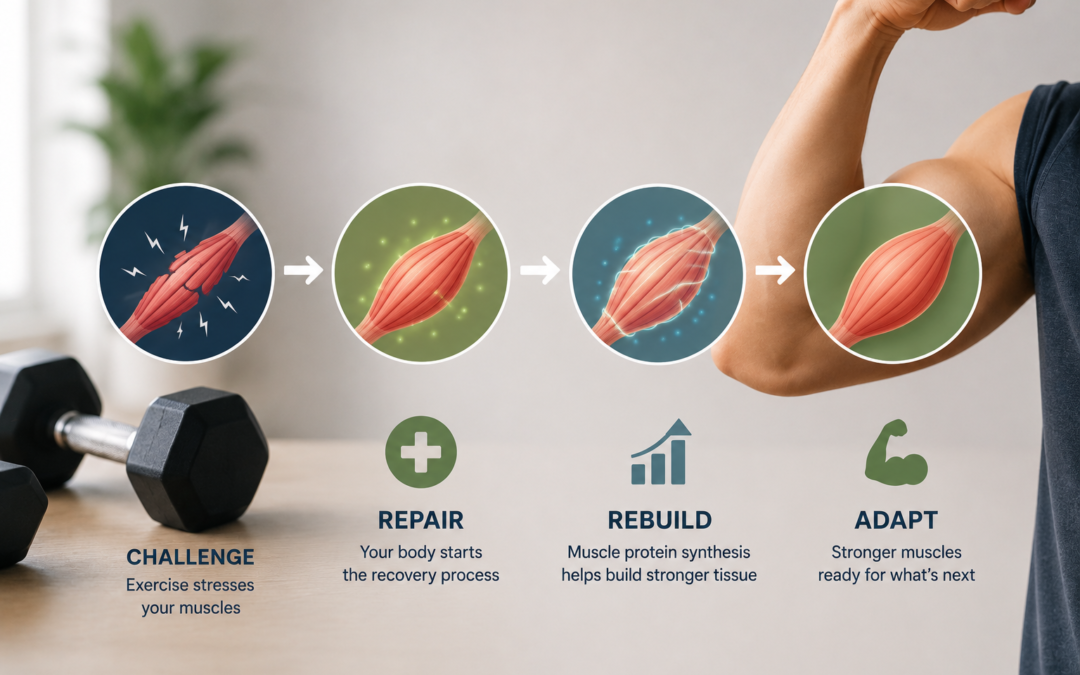
Exercise doesn’t make your muscles stronger on its own. Instead, it triggers a series of biological processes that allow your body to repair, adapt, and become stronger over time.
Understanding these processes helps explain why recovery is just as important as the workout itself.
Step 1: Exercise Challenges Your Muscles
Whether you’re lifting weights, climbing stairs, cycling, or playing sports, your muscles are placed under stress.
This mechanical stress is a normal and necessary part of exercise. It signals your body that your muscles need to adapt to future demands.
Contrary to popular belief, muscle growth isn’t simply about “breaking down” muscle. It’s about creating the right stimulus for your body to respond.
Step 2: Your Body Begins the Repair Process
After exercise, your body immediately starts repairing muscle tissue.
Specialized cells become active, damaged proteins are replaced, and muscle fibers begin rebuilding themselves.
This process requires:
- Amino acids from dietary protein
- Energy from food
- Water for normal cellular function
- Adequate rest and sleep
Without these essentials, recovery becomes less efficient.
Step 3: Muscle Protein Synthesis Increases
One of the most important recovery processes is muscle protein synthesis (MPS).
MPS is the process through which your body builds new muscle proteins to repair and strengthen muscle tissue after exercise.
When muscle protein synthesis exceeds muscle protein breakdown over time, muscles become stronger and better adapted to future activity.
This is why both exercise and proper nutrition are important—they work together to support muscle adaptation.
Step 4: Your Muscles Adapt
Recovery isn’t simply about returning to where you started.
Your body aims to prepare you for the next challenge.
As recovery progresses, your muscles may become:
- Stronger
- More efficient
- Better able to resist fatigue
- More prepared for future exercise
These adaptations occur gradually through consistent training followed by adequate recovery.
Why Muscle Soreness Isn’t the Goal
Many people believe that sore muscles mean they had a successful workout.
In reality, soreness is not a reliable measure of progress.
You can make excellent progress with very little soreness, while excessive soreness may simply indicate that your body needs more recovery time.
The goal isn’t to feel sore.
The goal is to recover well enough to continue improving.
Recovery Makes Adaptation Possible
Exercise provides the stimulus.
Recovery allows your body to respond.
Without enough sleep, proper nutrition, hydration, and time to recover, your muscles cannot fully complete the repair and adaptation process.
That’s why progress isn’t measured only by how hard you train, but also by how well you recover.
The Bottom Line
Every workout starts a remarkable biological process.
Your muscles receive a signal to adapt, your body begins repairing muscle tissue, muscle protein synthesis increases, and over time your muscles become stronger and more resilient.
The workout may only last an hour.
The recovery process continues long after you leave the gym.
Supporting that recovery through healthy lifestyle habits is one of the best ways to build strength, maintain muscle, and stay active throughout life.