
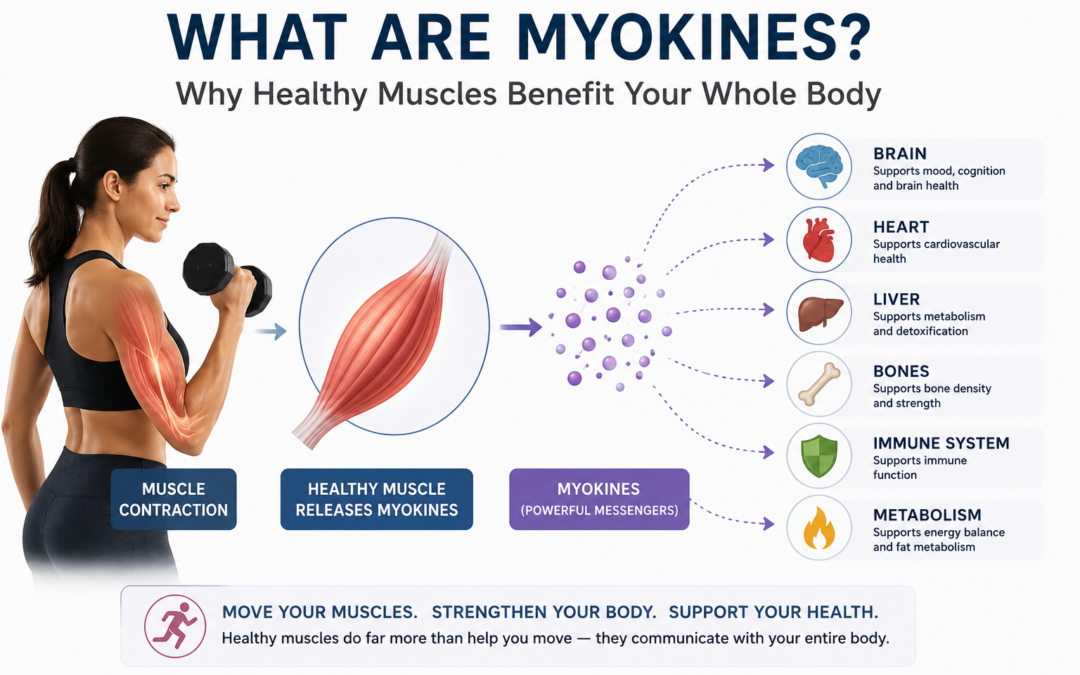
What Are Myokines? Why Healthy Muscles Benefit Your Whole Body
Most people think muscles are simply responsible for movement and strength.
But what if your muscles were also sending powerful messages throughout your entire body?
Over the past two decades, scientists have discovered that skeletal muscle is much more than tissue that helps us move. It is now recognized as one of the body’s largest endocrine organs, releasing hundreds of signaling molecules known as myokines.
These tiny molecules help muscles communicate with organs such as the brain, liver, bones, immune system, and fat tissue, influencing many of the health benefits associated with regular physical activity.
Your muscles don’t just move your body—they communicate with it.
This remarkable discovery is changing how scientists understand muscle health and why maintaining healthy muscles is important throughout every stage of life.
What Exactly Are Myokines?
Myokines are naturally occurring proteins and peptides produced and released by skeletal muscles.
They enter the bloodstream, particularly during and after physical activity, where they act as chemical messengers between muscles and other organs.
Scientists have identified dozens of different myokines, each with its own unique function. Some help muscles adapt after exercise, while others are involved in energy metabolism, inflammation, bone health, immune function, and cellular communication.
Although research is still evolving, myokines are now considered one of the most exciting discoveries in modern muscle science.
Why Are Myokines So Important?
For many years, researchers believed that the health benefits of exercise came mainly from burning calories and strengthening muscles.
Today, scientists understand that muscles also function as an endocrine organ, continuously sending important biological signals throughout the body.
Research suggests that myokines may help support:
- Healthy muscle recovery
- Muscle protein synthesis
- Energy metabolism
- Healthy inflammatory responses
- Blood sugar regulation
- Bone health
- Mitochondrial function
- Physical performance
- Healthy ageing
This growing body of research helps explain why regular physical activity benefits nearly every organ system—not just your muscles.
Your Muscles Communicate Every Time You Move
One of the most fascinating aspects of myokines is that they are naturally released whenever muscles contract.
Activities such as:
- Walking
- Resistance training
- Cycling
- Swimming
- Recreational sports
can all stimulate this natural communication system.
The type and amount of myokines released depend on factors such as exercise intensity, duration, and an individual’s fitness level.
This is one of the reasons why staying physically active supports overall health—not just physical fitness.
Muscle Health Is About More Than Strength
Many people associate muscles with athletic performance or physical appearance.
In reality, healthy muscles contribute to much more.
They support mobility, balance, recovery, independence, and the ability to perform everyday activities with confidence.
Scientists now recognize that healthy muscles also play an important role in maintaining communication throughout the body through myokines.
As we grow older, preserving muscle health becomes increasingly important—not only for maintaining strength, but also for supporting long-term health and quality of life.
Exercise and Nutrition Work Together
Regular exercise is the strongest natural stimulus for myokine production.
At the same time, proper nutrition provides the building blocks muscles need to recover, repair, and adapt.
Researchers are now exploring how specific nutrients and bioactive peptides may support muscle function and influence the biological pathways involved in muscle health.
This is a rapidly growing area of research, and new discoveries continue to improve our understanding of how nutrition and exercise work together to support healthy muscles.
Key Takeaways
Research into myokines is advancing rapidly, and scientists continue to discover new ways that muscles communicate with the rest of the body.
While much remains to be learned, one message is already clear:
Healthy muscles do far more than help us move—they help keep the entire body functioning at its best.
You don’t need to become an elite athlete to benefit. Small, consistent habits can make a meaningful difference.
To support healthy muscles:
- Stay physically active every day.
- Include resistance exercise in your weekly routine.
- Eat a balanced diet that supports muscle health.
- Get enough sleep to allow your muscles to recover.
- Maintain muscle strength throughout every stage of life.
Every step you take to care for your muscles is also an investment in your long-term health.
Healthy muscles don’t just help you move—they help your whole body thrive.