
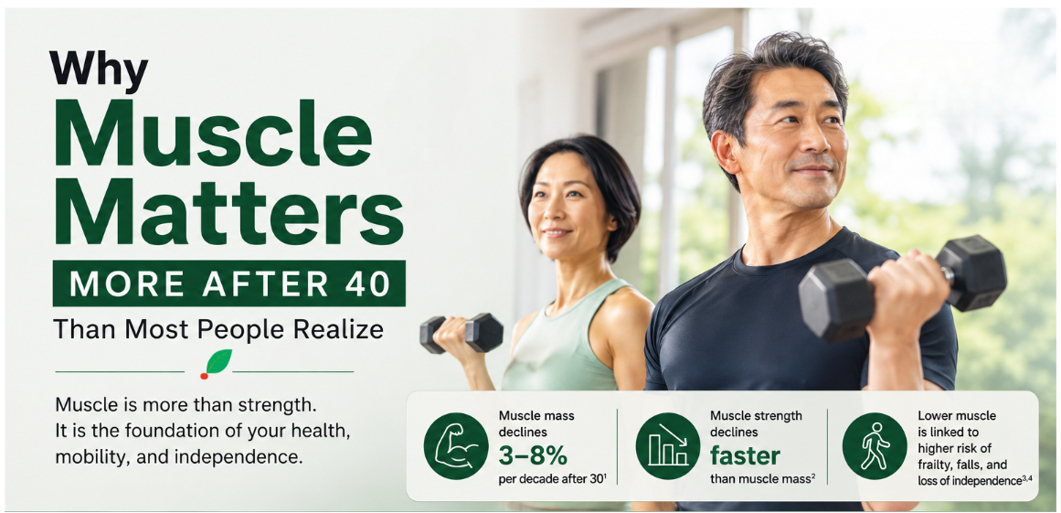
Most people notice changes in their bodies after the age of 40.
Energy levels may feel different. Recovery from exercise may take longer. Strength may not come as easily as it once did.
What many people do not realize is that one of the most important changes happening beneath the surface is the gradual loss of skeletal muscle.
While weight gain often receives the most attention, muscle loss may be the more important health issue.
Muscle Is More Than Strength
When people think about muscle, they often think about athletes, bodybuilders, or appearance.
In reality, muscle plays a critical role in overall health and wellbeing.
Healthy muscle helps support:
- Physical strength and mobility
- Metabolic health
- Blood glucose regulation
- Balance and stability
- Bone health
- Recovery from illness and injury
- Healthy aging and independence
Muscle is not simply about performance. It is one of the body’s most important organs for long-term health.
The Silent Loss Begins Earlier Than Most People Think
Research suggests that muscle mass begins to decline as early as our 30s.
Studies have reported an average loss of approximately 3% to 8% of muscle mass per decade after age 30, with the rate of decline accelerating later in life.
Some researchers estimate that muscle loss can begin during middle age at a rate of approximately 1% per year. In severe cases, individuals may lose up to 50% of their muscle mass by their 80s.
The process is known as sarcopenia, a progressive age-related loss of muscle mass and function.
Importantly, the decline is not limited to muscle size. Muscle strength often decreases faster than muscle mass itself.
Research has shown that muscle strength can decline significantly after the age of 40, reducing physical function and increasing the risk of future frailty.
Why Does Muscle Decline With Age?
Muscle aging is influenced by multiple biological factors.
These include:
- Reduced anabolic hormone activity
- Lower growth hormone and IGF-1 levels
- Increased inflammation
- Reduced physical activity
- Insulin resistance
- Changes in nerve-muscle communication
- Inadequate protein intake
- Reduced responsiveness of muscle to nutrition and exercise
Over time, the body becomes less efficient at maintaining and rebuilding muscle tissue.
As a result, preserving muscle requires a more intentional approach than it did in younger years.
Why Muscle Matters for Healthy Aging
One of the strongest predictors of healthy aging is the ability to remain physically independent.
Muscle plays a central role in maintaining that independence.
Individuals with higher muscle strength are generally better able to:
- Perform daily activities
- Maintain mobility
- Reduce fall risk
- Recover from illness
- Preserve quality of life
Researchers increasingly view muscle health as a cornerstone of healthy aging.
In fact, age-related muscle loss has been associated with frailty, disability, hospitalization, and loss of independence.
Muscle Health Is Important for Women Too
Muscle loss is often discussed in the context of men, but it is equally important for women.
Research suggests that the menopausal transition may accelerate declines in lean body mass.
Women who maintain healthy muscle levels are more likely to support mobility, metabolic health, and long-term physical function as they age.
For this reason, muscle health should be considered a lifelong priority for both men and women.
The Good News: Muscle Can Be Supported
Although age-related muscle loss is common, it is not inevitable.
Research consistently shows that lifestyle choices can help support muscle health throughout life.
Key strategies include:
Resistance Exercise
Strength training remains one of the most effective ways to stimulate muscle maintenance and development.
Adequate Nutrition
Protein and other muscle-supportive nutrients play important roles in maintaining muscle tissue.
Recovery
Muscle adaptation occurs during recovery, making sleep and recovery practices essential.
Consistency
Long-term habits are more important than short-term intensity.
Small actions performed consistently can have meaningful effects over time.
Looking Beyond the Scale
Many people monitor their body weight.
Far fewer monitor their muscle health.
However, two individuals with the same body weight can have dramatically different levels of muscle mass, strength, and physical function.
As we age, maintaining muscle may be one of the most valuable investments we can make in our future health.
The goal is not simply to live longer.
The goal is to remain strong, active, capable, and independent throughout life.
After 40, muscle is no longer just about performance.
It becomes a foundation for healthy aging.
Clinical References
- Volpi E, et al. Muscle tissue changes with aging. Muscle mass decreases approximately 3–8% per decade after age 30.
- Wilkinson DJ, et al. The age-related loss of skeletal muscle mass and function. Muscle loss begins from middle age at roughly 1% per year and may reach ~50% by the eighth or ninth decade.
- Keller K, Engelhardt M. Strength and muscle mass loss with aging process. Muscle strength declines significantly after age 40.
- Larsson L, et al. Sarcopenia: Aging-Related Loss of Muscle Mass and Function. Sarcopenia is associated with reduced mobility, lower quality of life, and increased risk of injury and disability.
- Buckinx F, et al. Sarcopenia in Menopausal Women. Menopause is associated with accelerated loss of lean body mass and increased sarcopenia risk.


vital nutri® is a science-driven nutritional supplement brand dedicated to supporting strength, resilience, and long-term vitality.
Manufactured in Japan under strict GMP standards and formulated with carefully selected ingredients, our products support strength, recovery, cognitive performance, and sustainable wellness.
vital nutri® is a brand of BIC GROUP Ltd., a healthcare company focused on innovation, science-driven development, and advancing global health standards.
Site Map
Contact
BIC GROUP Ltd
Shin-Kokusai Bldg 4F,
3-4-1 Marunouchi, Chiyoda-ku,
Tokyo 100-0005 JAPAN